
A tumultuous time in the game industry is underscored by ICE at GDC fears

The annual State of the Game Industry report details a year of struggle
In response to a question about how GDC Festival of Gaming will react to ICE agents if they request information about attendees or to access the convention, I was told that organizers are in “discussions with the mayor’s office … about the safety, security, and overall experience of attendees.”
When asked earlier for specifics about the discussions between city officials and GDC, I was referred to a post on X (formerly known as Twitter) by San Francisco Mayor Daniel Lurie in which he underscores the priorities of local law enforcement as protecting public safety, “including the right to peaceful expression.”
“We will continue to uphold San Francisco’s longstanding policies that keep local law enforcement focused on keeping our city safe—not federal immigration enforcement,” the mayor wrote. “If you see SFPD on the street, they are there to keep you safe, not to assist immigration enforcement.”
Earlier in the week, I raised concerns some have about the safety of international visitors to the show with GDC Executive Director, Innovation & Growth, Mark DeLoura.
When I asked whether organizers have discussed the possibility of ICE agents coming to GDC, which runs from March 9 to March 13, to conduct visa checks among attendees, DeLoura said they have had a range of conversations.
“We have really good partners in San Francisco in the mayor’s office as well as at the state level,” he said. “So that’s helpful for sure.
“These are questions that are very appropriate, and we think about a lot. I really think of GDC as being an international event, so I want it to be safe for international people.”
It’s not the sort of thing you might typically think about for a video game development conference, but with increasingly out-of-control Immigration and Customs Enforcement and Border Patrol agencies shooting and killing two people in the past month, it’s a question on the minds of some considering a trip to the United States.
Operation Metro Surge, which kicked off in December, has seen an increase in the brutality of ICE and Border Patrol, as well as the detention of U.S. Citizens and people lawfully allowed to visit or stay in the country.
Both France and Germany have issued advisories to their citizens planning to travel to the U.S., warning them to avoid Minneapolis in particular.
Over on LinkedIn, business development and strategist Cassia Curran wrote that “GDC is going to be very empty of Europeans this year.” And noted developer and consultant Rami Ismail wrote that when asked for travel tips to DICE and GDC, his reply was “Cancel. Genuinely. Cancel.”
“Unless you’re white, and fit the racist, sexist, and supremacist ideal of Trump’s US, or can pass as such, you already have reasons to be rejected,” he added. “Even if you are ‘perfectly’ Trump-approved, you are at risk of being the next news story of a foreigner being rejected or detained at the border.
“And I really need you to understand that *any* rejection or detention at the border is a permanent mark against entry, forever. That mark will stick past Trump’s eventual defeat, and it is unlikely future governments will allow appeal or go through case by case.”
All of this does beg a question, DeLoura noted:
“If we’re throwing an event for all game developers, why do we have an event just in the United States?”
That is something they’ve been looking into, he added.
Following my interview with some of the GDC folks earlier this week, the team sent over a statement from Nina Brown, president of the GDC Festival of Gaming.
“The GDC team regularly evaluates (and will continue to consider) locations based on attendee feedback, logistics, venue capacity, and accessibility,” she said in the statement. ”To address those concerns around travel and lodging costs, GDC works closely with local hotel partners to offer discounted rates to attendees, and works with the City of San Francisco to offer discounts for local businesses around the city.
“As event organizers, we are always assessing how we balance the choice of location alongside venue infrastructure, hotel capacity, and international travel access, to ensure that the event experience is the best it can be for our attendees from the moment they arrive.”
She also said that the folks at GDC “appreciate the concerns that some of our community have expressed in the lead-up to GDC Festival of Gaming. We work with local officials and legal experts to monitor any US policy changes, and our guidance to our international community members is to begin visa applications early and consult with their embassy on any additional requirements.”
Brown added that the convention’s safety and security initiatives in and around Moscone Centre include a 24/7 safety hotline, San Francisco Safety Community Ambassadors stationed around the center, security escorts upon request, and expanded training for festival crew.
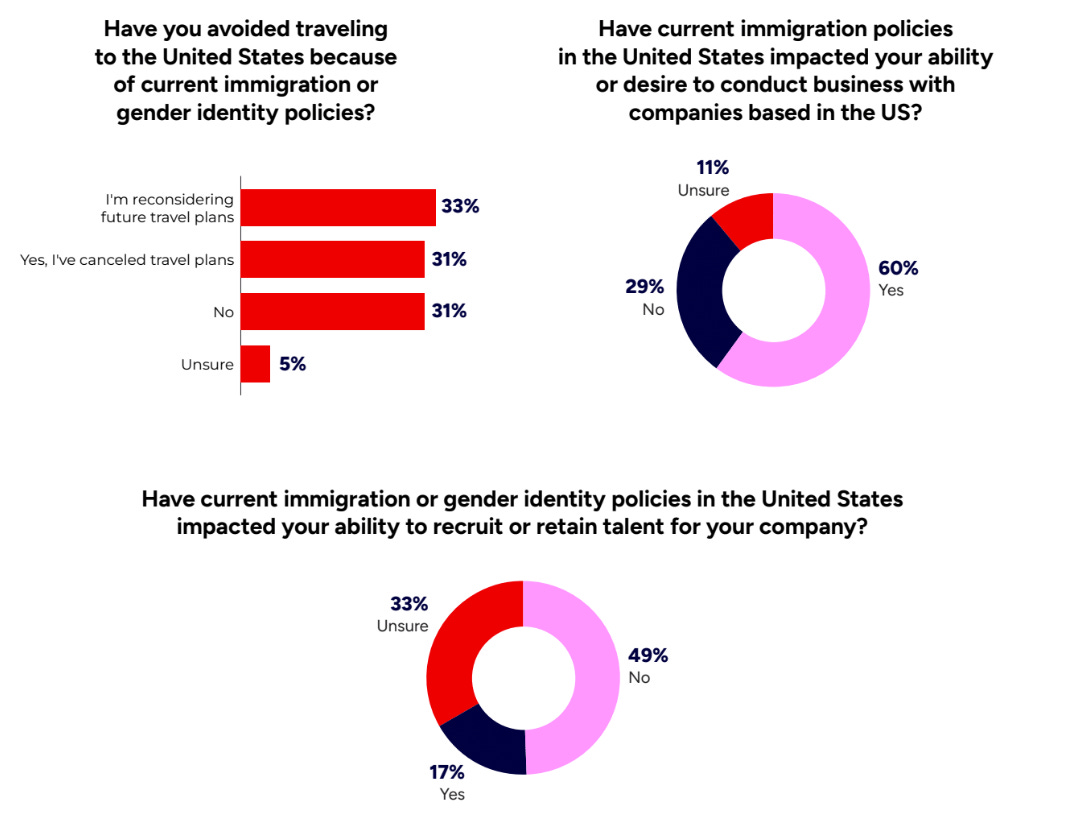
While Brown noted that the organizers are seeing global participation from more than 60 countries so far, almost one-third (31 percent) of those surveyed by GDC last month for its annual State of the Game Industry report had already canceled travel plans to the U.S., and one-third were reconsidering future plans. It’s unclear what the past month’s events in Minneapolis might have had on that number.
The 2026 State of the Game Industry report was released by the GDC Festival of Gaming today.
While the negative impact U.S. immigration policies are having on the industry is perhaps the most timely fact in the survey, the deep dive into the state of the video game industry offers insight into myriad facets of the current state of game development.
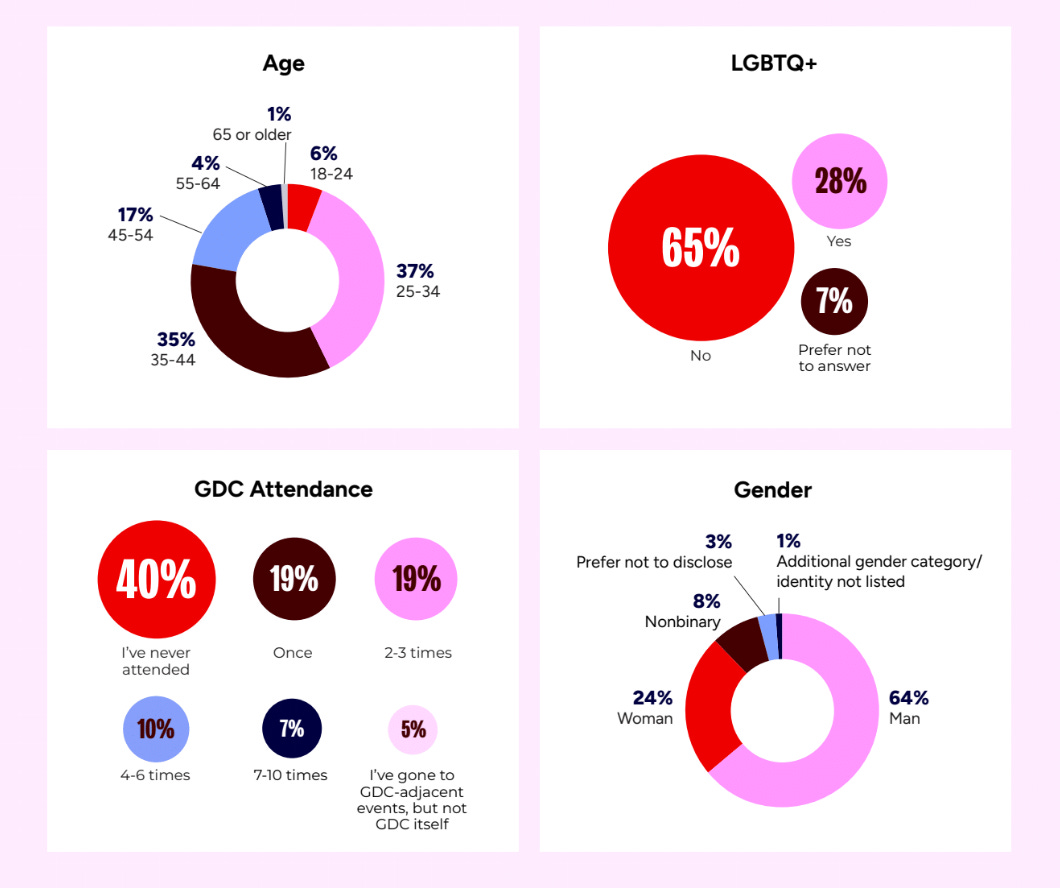
The report, which surveyed 2,300 game industry professionals, highlights several troubling issues facing game developers today.
That includes the fact that layoffs have increased, not diminished, in the past year, that generative AI’s use is increasing despite those surveyed increasingly disliking it, that three-quarters of those surveyed regularly work more than 40 hours a week, and that, despite 82 percent of those who responded wanting to unionize, only 12 percent are.
There are also some interesting points that aren’t so bleak in the survey. For instance, the use of Unreal Engine in the making of games now surpasses Unity, and developing a game for a handheld PC system seems to hold an allure for many of those surveyed.
The kind folks behind the report spent an hour or so walking me through the findings and answering some questions about it. But before we dive in, an interesting, data-specific point. (ha)
Beth Elderkin, the primary author and researcher for the annual report, noted that the team decided to change the way they conduct the survey this time around. So, you can’t compare this year’s report to the previous year’s. It’s not apples to apples.
“We really wanted to reexamine the state of the game industry and figure out how to best represent the full game ecosystem,” Elderkin said. “I have long had a personal philosophy … that if you are part of making a game exist, you are a developer. So I wanted to dig deeper into State of the Game Industry and … figure out how I can better represent the game community and give them more of a chance to share their expertise.”
This time, the survey ensured that those with specific expertise could respond to questions relevant to their areas.
But, in general, the first year-over-year comparison won’t be possible until next year’s results.
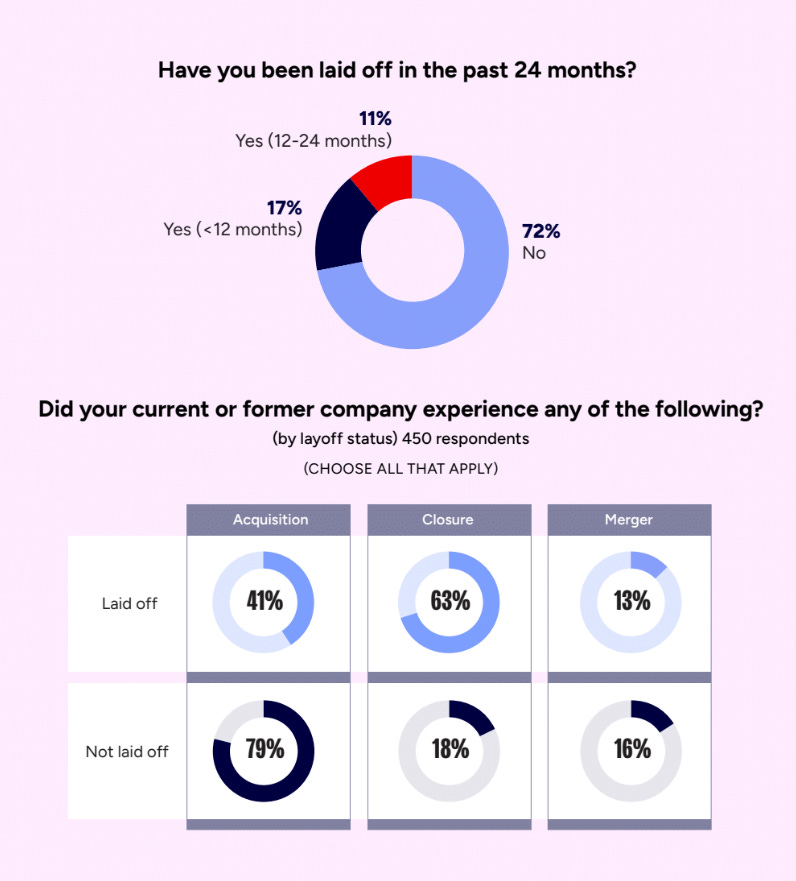
Perhaps the biggest news coming out of the survey won’t be too surprising to those who work or have worked in the game industry: one in four video game professionals has been laid off in the past two years.
Despite the hope that the post-pandemic surge of layoffs would be over by now, it appears that not only has it not stopped, it’s gotten worse.
The top three reasons those layoffs happened, according to those surveyed, were “company restructuring,” “budget cuts,” and “market conditions.” The sentiment makes it clear that employees don’t view these or the other reasons given as valid.
Among that list of reasons for layoffs was automation and AI implementation, but only six percent thought that was the reason.
The AI-related questions yielded some curious results. Specifically, 36 percent of respondents said they use generative AI tools in their work. But before you pull out the pitchforks, know that the way they’re using it sounds mostly mundane. For instance, about half use it for writing emails, scheduling, or other daily tasks. About 81 percent said they use it for research or brainstorming, but only 5 percent said they use it for play-facing features.
More interestingly, 52 percent of respondents believe generative AI is harmful to the industry. In this case, the survey included last year’s responses, noting that only 30 percent considered it bad, and in the 2024 report, only 18 percent did.
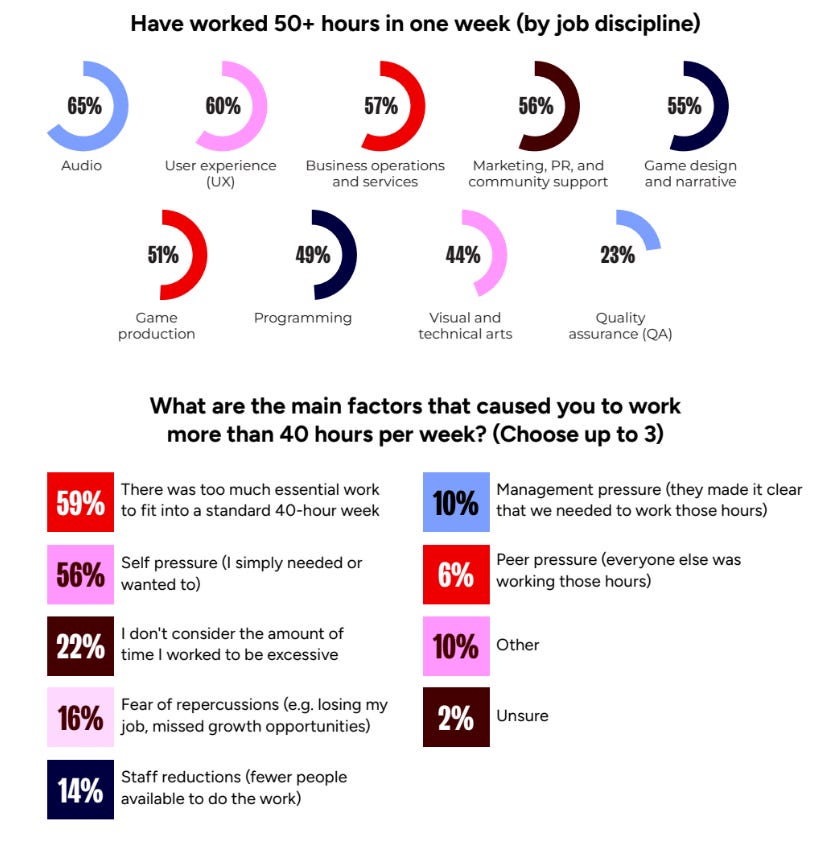
The state of work in the game industry remains challenging, with half of game workers reporting that they put in 50 or more hours a week, and a whopping 21 percent saying they worked 60 hours or more in a single week over the past year.
The main reason given for the crunch (59 percent) was that “there was too much essential work to fit into a standard 40-hour-week,” right behind that was “self-pressure.”
So it shouldn’t be surprising that 82 percent of those surveyed in the United States said that they support unionization, while only 12 percent are actually in one. Interestingly, 58 percent of owners and executives from companies with at least 20 employees said they supported unionization.
Despite the fact that the past year has seen a shockingly large shift away from DEI programs and initiatives at large companies like Meta and Disney, 63 percent of those surveyed said they haven’t seen any changes related to diversity, equity, and inclusion, while 23 percent said they were unsure. The same can’t be said for schools, unfortunately, with 47 percent reporting they have.
Personally, the questions I found most interesting were those pertaining to the way the rest of the world views the U.S., given the current state of shocking, over-the-top immigration enforcement, and seemingly arbitrary use of tariffs.
About 38 percent of respondents said U.S-based tariffs are impacting their expenses, revenue, or financial decisions.
About 60 percent of non-US industry leaders and investors said current immigration policies have impacted their ability or desire to do business with American companies. While 18 percent of those at companies with at least 20 employees said that immigration and gender identity policies have impacted their ability to recruit or retain talent. That goes up to 21 percent when asking people who work at companies with at least 100 employees.
Elsewhere

Toxic Commando: Fusing blood, mud, and John Carpenter

Indonesian indie game Kejora’s journey from Cuphead shoot-’em-up to puzzle platformer

Our Resident Evil Requiem hands-on preview reveals fresh, frightening features